
CEDES
In the service of safety and convenience
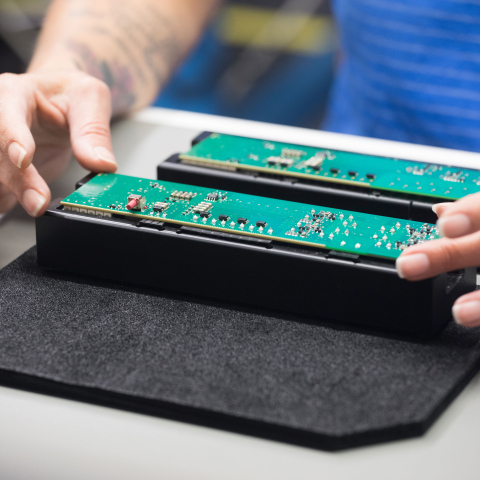
High-tech sensors from Landquart
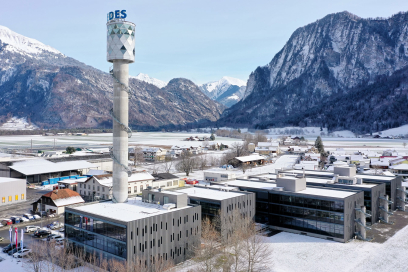
Have you ever given lifts much thought? Probably not. For most people, they exist to do precisely two things: go up and go down, attracting as little attention as possible along the way. To make that happen, companies such as CEDES focus on the details that nobody else needs to think about. In Landquart, Graubünden, surrounded by mountain views and Alpine air, more than 200 employees put in “an enormous amount of work”, as lead engineer Marcial Lendi explains.
The end user probably sees about 20 per cent of the work that goes into a lift.
Marcial Lendi
Preventing misunderstandings
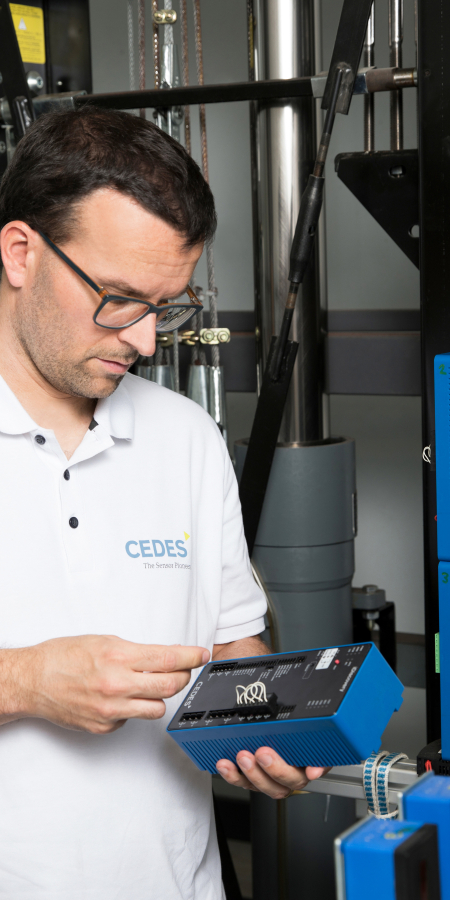
For the past five years, Lendi and his team have been developing their flagship product, iDiscovery. “iDiscovery monitors safety-critical components such as the motor and brake to make sure they function correctly,” he says. Lifts, it turns out, are rather like people: the more communication there is, the greater the scope for misunderstandings. These days, even a single button in a lift car has multiple wiring connections. And although a modern lift can technically no longer fall down the shaft, “there is always a chance it won’t do what it is supposed to.”
Lift travel as we know it began in May 1854. The story goes like this: at a forerunner of today’s World Expo, lift pioneer Elisha Graves Otis takes a showman’s advice and has himself raised to the ceiling on his goods lift. Once he has the audience’s full attention, he draws a sabre and cuts the supporting ropes. The lift plunges downwards, but stops after just a few centimetres. Otis’s safety brake works. Just three years later, the first passenger lift entered service, opening up new possibilities for taller buildings.
In future, lifts may do away with ropes altogether. In Rottweil, Germany, Thyssenkrupp is developing lift cars that use magnetic propulsion to travel along parallel rails. They move not only up and down, but sideways too. This allows several cars to operate simultaneously and overtake one another, avoiding congestion and opening up new spaces. “It might sound crazy,” says Marcial Lendi. “But you have to start somewhere.” Elisha Graves Otis would almost certainly agree.
More about CEDES
Every detail adds up
A picture of Otis stands in one of the meeting rooms at CEDES. Lendi himself wears a T-shirt bearing the words “The Sensor Pioneers”. It is an apt description, even if today’s revolutions have become more subtle. In a highly technological world, it is the sum of many details that makes them possible. It is about fork sensors, sensing technology and competition from China.
With iDiscovery, Lendi and CEDES are finding ways to improve lift travel in a fiercely competitive high-tech market. For manufacturers, he develops technology that remains competitively priced while maintaining or improving quality. For passengers, it makes travelling between floors even more comfortable. For technicians, it makes installation and maintenance safer despite growing time pressures. This is where most accidents happen, because “even experienced technicians can make a mistake.”
Contactless sensors
For all its down-to-earth Graubünden roots, CEDES also contributes to ambitious visions. Its technology helps make the magnetic lift prototypes in Rottweil work. “At the moment, we are the only company making safety sensors that work without physical contact,” says Lendi. There is no friction and therefore no wear. Yet one thing is likely to remain true through every revolution: “The end user probably sees about 20 per cent of the work that goes into a lift.”
Keep that in mind the next time you simply want to travel a few floors up or down and press a button with multiple wiring connections.


