
Hamilton
Living constants live
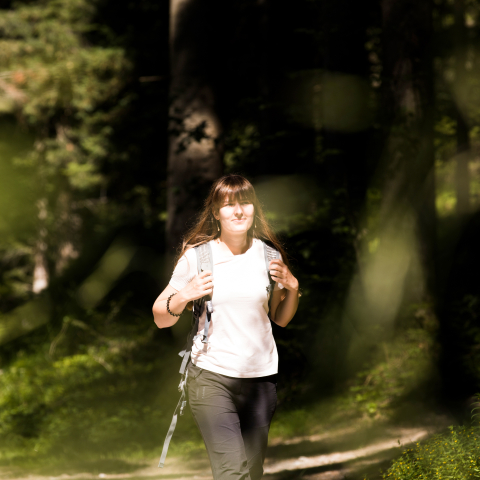
For three years, Gabriela Fisch commuted from St. Gallen to Zurich on a daily basis, from her parents’ house to the ETH. “I didn’t even have to change train,” she says, explaining her decision. It’s the small things that determine her life’s major paths. To describe Gabriela as an enthusiast would be a slight exaggeration. But it would also be wrong to say otherwise.
120 millimetres long, a 12-millimetre shaft diameter, one sensor head, jam-packed with electronics – the dimensions within which Gabriela operates in her work are negligible. The 27-year-old’s work at Hamilton in Bonaduz in Graubünden is dedicated to researching and developing new process sensors. “When I accepted this job, I had no idea what was in store for me.” What appeals to her most about it now is the interdisciplinary cooperation. For every project, there’s a different team, and each team is made up of members from different disciplines: chemists, physicists, electrical engineers and mechanical engineers. One thing that doesn’t change is the role Gabriela plays in all of these, where she applies her expertise as a mechanic. “If I were surrounded by mechanical engineers the whole time, I probably wouldn’t learn anything different.”
If I were surrounded only by mechanical engineers, I probably wouldn’t learn as much.
Gabriela Fisch
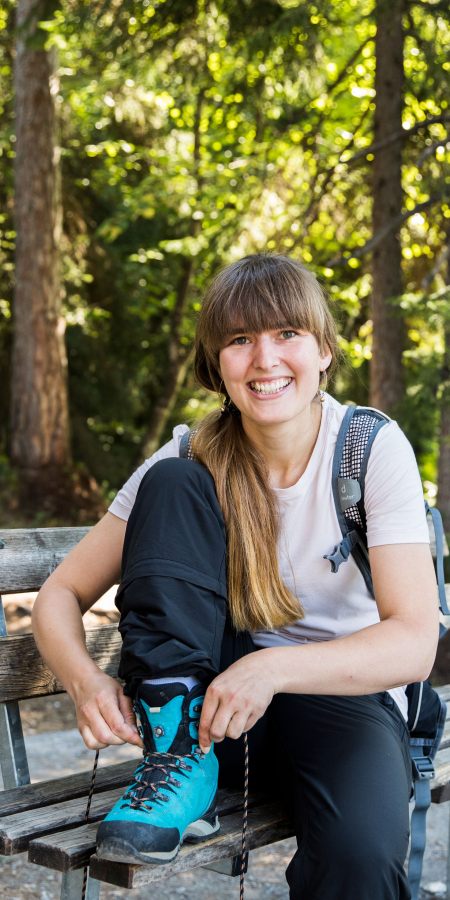
For three years, Gabriela Fisch commuted from St. Gallen to Zurich on a daily basis, from her parents’ house to the ETH. “I didn’t even have to change train,” she says, explaining her decision. It’s the small things that determine her life’s major paths. To describe Gabriela as an enthusiast would be a slight exaggeration. But it would also be wrong to say otherwise.
120 millimetres long, a 12-millimetre shaft diameter, one sensor head, jam-packed with electronics – the dimensions within which Gabriela operates in her work are negligible. The 27-year-old’s work at Hamilton in Bonaduz in Graubünden is dedicated to researching and developing new process sensors. “When I accepted this job, I had no idea what was in store for me.” What appeals to her most about it now is the interdisciplinary cooperation. For every project, there’s a different team, and each team is made up of members from different disciplines: chemists, physicists, electrical engineers and mechanical engineers. One thing that doesn’t change is the role Gabriela plays in all of these, where she applies her expertise as a mechanic. “If I were surrounded by mechanical engineers the whole time, I probably wouldn’t learn anything different.”
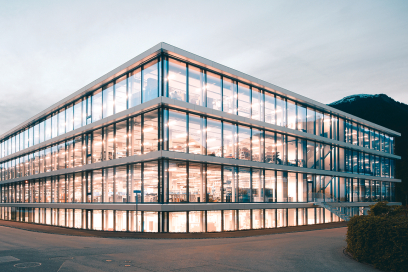
Hamilton.
Further information
Some of the work done in teams includes the development of sensors for biopharmaceuticals. “The aim is to ensure that the desired active ingredient can be produced,” says Gabriela, breaking the aim of her work down into everyday language. In technical jargon: the sensors monitor all the critical parameters required to monitor bioprocesses in real time, including dissolved oxygen, pH value, cell density and conductivity. This makes the process controllable. It can take years to take the initial idea and implement it in practice. Until then, it’s all developing, testing, developing, testing – or “tinkering” as Gabriela calls it – until the initially centimetre-wide sensors measure no more than 12 millimetres.
According to Gabriela, it was pure coincidence that she ended up in her job. It was by chance that she went to a springboard event in the canton of Graubünden and a coincidence that she was drawn to Hamilton, which happened to have a position to fill. But in spite of all the coincidence, mechanical engineer Gabriela is nothing if not consistent. Even as a child, she was interested in the production business her father ran. Whenever it was Bring Your Child to Work Day, she would be there with him, and later on working there in the summer holidays. “The people there knew me by that point anyway.” Later, she opted to study maths and physics. Not out of a passion for those subjects, she stresses, although “there were very few women”, but certainly interest.


