
Arbeiten in Graubünden
Shining lights
Technology of the future
How light is changing our everyday lives
What is photonics? In simple terms, it is the science and technology of light. It enables our smartphones to recognise faces in milliseconds and partially autonomous vehicles to warn us of road hazards in time.
This technology lies behind ultra-thin OLED displays, intelligent sorting systems, laser-cut spectacle lenses, medical endoscopes, ultrafast fibre-optic networks and touchless bathroom sensors. Photonics already touches every area of life and will become standard in tomorrow’s engineering.
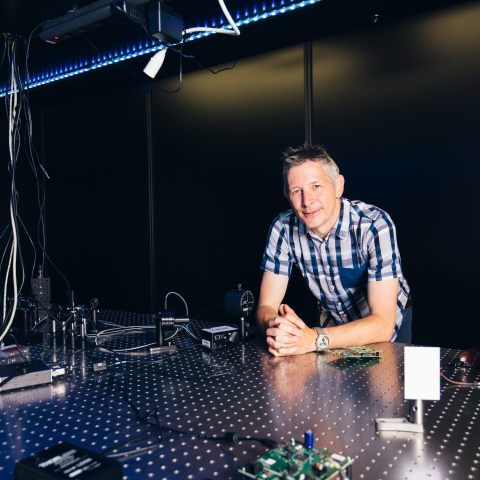
“Understandably, there is still a considerable need to explain what photonics is,” says Professor Dr Tobias Leutenegger, Head of the Photonics degree programme at FH Graubünden. Leutenegger, who worked in industry after completing his doctorate at ETH Zürich, is passionate about his subject. He knows that students here do far more than study theoretical physics: from the outset, they develop tangible technologies that improve everyday life.
Hands-on experience from the first semester
Photonics at the FHGR
The bachelor’s degree programme in Photonics at the university of applied sciences Graubünden (FHGR) stands out for its strong practical focus. Students spend around 20 per cent of their study time working in the laboratory, soldering and assembling equipment as well as programming and configuring systems. It is an ideal starting point for anyone with a keen interest in technology and a passion for hands-on innovation.
FHGR offers a unique interdisciplinary environment. Students joining from academically oriented upper secondary schools learn alongside qualified electronics technicians, IT specialists, opticians, mechanical engineering technicians and physics laboratory technicians. They all study in small, close-knit groups and benefit from personal guidance and support from their lecturers.
With a smile, programme director Tobias Leutenegger describes the teaching philosophy as “guided trial and error”: “In the laboratory, we make sure nothing dangerous happens and that students can safely pick themselves up again. But once they’ve made a mistake themselves and worked out how to fix it, they never forget it. That’s how you learn real engineering, and that’s how innovation happens.”
Close partnerships with industry
Excellent career prospects
There is a simple reason why FH Graubünden graduates are in such high demand: the technology sector is growing rapidly and urgently needs photonics specialists with practical expertise. To make the transition from study to employment as seamless as possible, the university works closely with industry. A strong network of around 50 leading regional and national high-tech companies is directly involved in the programme’s design.
Many students work on real projects for these companies during their studies, building valuable connections with future employers. The results speak for themselves: the vast majority of graduates have already signed an employment contract before officially completing their degree. For parents, studying at FHGR therefore offers the reassurance that their children are receiving an excellent, forward-looking education that leads directly to challenging roles resilient to economic downturns.


