A lifetime’s work, one mission
Spaces and stories
We need both: to preserve what has grown here and to welcome influences from outside.
Giovanni Netzer Founder and Director, Theater Origen Festival Cultural
Spaces and stories are the two themes that drive Giovanni Netzer. His mission is to bring them together, drawing on everything from theatre and music to philosophy, gastronomy and architecture. There could hardly be a more fitting place for our conversation than the Red Tower on the Julier Pass. Not simply because Giovanni Netzer imagined it and made it possible, but because, in many ways, it resembles him. Both thrive on the atmosphere created when worlds collide. Both look far beyond their immediate surroundings without losing sight of what is close at hand. Both absorb whatever their environment offers and turn it into an experience for all the senses.
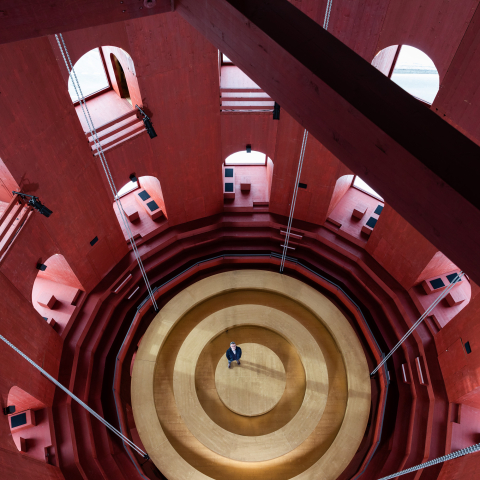
We sit on the first floor of the tower, on a stage suspended from steel cables that can lift it all the way to the roof. Above us, the structure rises almost thirty metres. Through its many windows, we watch cars pass. Again and again, people stop, step out, stretch their legs and marvel at a building that, despite being three years old, seems to have lost none of its power to challenge expectations. Connected to the outside through all those windows, we feel sheltered yet part of the landscape, almost spiritually humbled by the immense mountains.
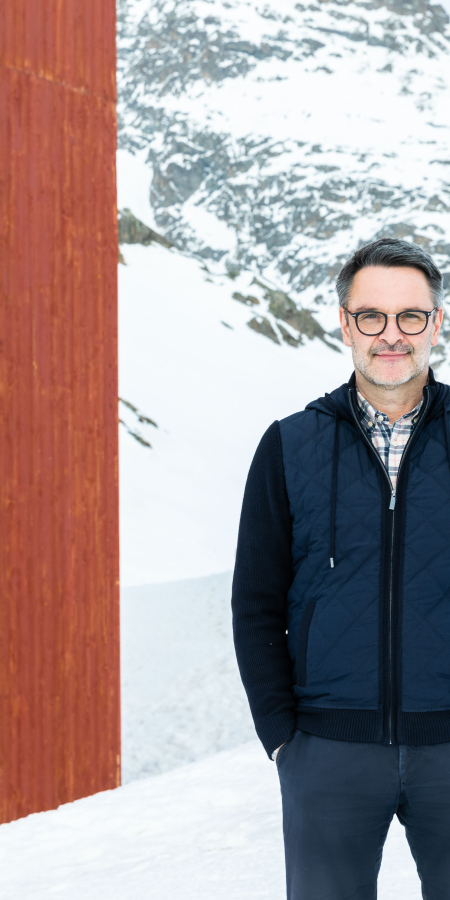
The tower has something of a sacred space about it, which makes sense given that Giovanni Netzer, born in 1967, is also a theologian. “Yes, up here you find yourself thinking about eternity,” he says. “As with all our projects, the tower was about questioning how theatre, or culture more broadly, can happen. Does it really have to be a proscenium stage? What if the action unfolds from the centre? What if the vertical space plays a part? Why not use real sunlight instead of an imitation of light in an artificially darkened room? Do we have to control everything?”
Questioning is Giovanni Netzer’s modus operandi. He approaches everything with disarming curiosity, gentle humour and an openness to whatever else might emerge once a subject is brought into focus. Stories, in other words. That also explains theology: religion, too, rests on stories, myths and narratives, and on how people engage with them and what they make of them. In other words, culture.
After two years studying theology in Chur, he moved to Munich, where he went on to study theatre after completing his degree. He stayed in the Bavarian capital for ten years. Yet returning to Graubünden had always been part of the plan, says Netzer, who comes from Savognin. He never stopped thinking about what defines the canton, what it offers and what its future might hold. “We need both: to hold on to and preserve what has grown here, what makes this place home, while also welcoming outside influences and the fresh perspective of those who return.” He is not referring to himself, although he is one of them. He means people such as Jean Jegher, one of the many confectioners from Graubünden who returned to their roots after cosmopolitan careers. Jegher, for example, commissioned the magnificent White Villa in Mulegns, a small village on the road to the Julier Pass.
One of the more spectacular projects undertaken by Netzer’s Origen foundation was to buy the villa, catalogue its contents, renovate it and move the entire building eight metres so that the pass road could be widened at that point. Today, it serves as a café, theatre and cultural venue. None of Netzer’s projects fits neatly into a single category. The same is true of the Post Hotel Löwe, also in Mulegns. The dilapidated grand hotel had always fascinated Netzer, especially after he and Origen researched its history. American presidents, English queens, Russian empresses, Albert Schweitzer and Wilhelm Conrad Röntgen had all stayed here: their journeys took them through the narrow streets of Mulegns. Today, in its new era under Netzer, the hotel is a hotel once again, but naturally much more besides.
For sixteen years now, Netzer has been bringing Graubünden to life through Origen, placing it on the international map as a cultural hotspot as well as a tourist destination. He does so with the sensitivity of a local who knows and understands the place and its people, combined with the expansive, unconstrained outlook of a citizen of the world. What does the future hold? Netzer remains open to everything. That is precisely what defines him.