
Education and research in Graubünden
Always in motion – natural hazards
Research for safe Alpine regions
When the mountain begins to move
Nature demonstrates vividly that it follows its own course and is constantly in motion. Thanks to continuous research, however, scientists can predict many natural phenomena and hazards and take practical action at an early stage. The aim is to protect people, but also, and especially, to protect nature.
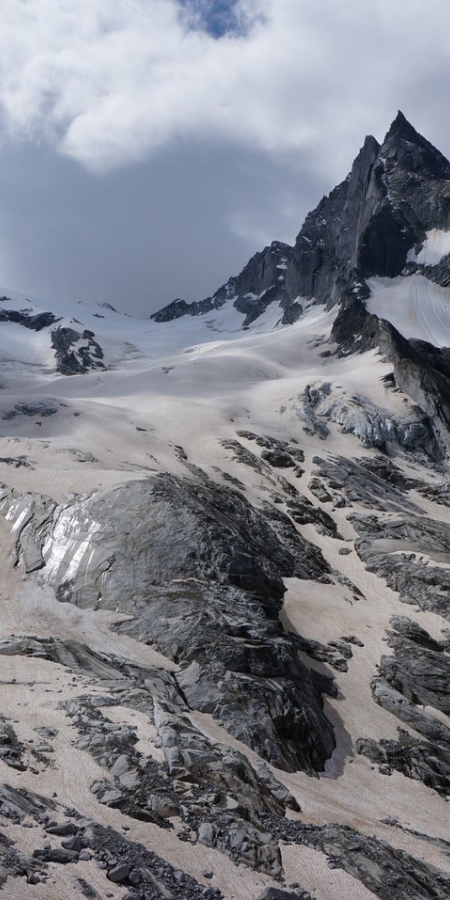
In 2022, Swiss glaciers lost around three cubic kilometres of ice – a thought-provoking record. More thought-provoking still, climate change and steadily rising average temperatures are taking their toll on this frozen element. One focus of the CERC research centre in Davos is therefore permafrost, the natural cement that holds mountains and rock together. When it thaws, rockfalls and debris flows occur, with major consequences for Alpine infrastructure. Mountain railways, infrastructure at altitude, and the protection of villages and access routes must be designed and adapted accordingly. CERC, which is part of the WSL Institute for Snow and Avalanche Research SLF, continuously monitors conditions in Graubünden's Alpine regions. On that basis, it plans the measures and precautions required to act early, as in Brienz, and to forecast avalanches. Digitalisation has also made research easier for established and emerging scientists in Graubünden and enabled new forms of collaboration.
Glaciers can and must be allowed to recover
The University of Applied Sciences Graubünden also conducts glacier research, while its Institute of Construction in Alpine Regions (IBAR) offers bachelor's programmes in Architecture and Civil Engineering. Alongside the traditional foundations, particular emphasis is placed on the special construction solutions required in the Alpine region. The work is carried out both on and with the mountain. In the applied glaciology research field, students explore in depth how glacier mass can be preserved. The Physikalisch-Meteorologisches Observatorium Davos and World Radiation Centre (PMOD/WRC) has studied the influence of solar radiation on the Earth's climate since 1907, with research extending beyond global warming. Instruments developed in this context are used both in space and on the ground.
The feasibility study for the MortAlive glacier-care project presents visionary possibilities. Yet pragmatic, if labour-intensive, measures are already being implemented in Graubünden today. At several locations, for example, parts of glaciers are effectively protected from the sun with textile covers. This gives the mountain an opportunity to recover at its core and build up new ice.
Working together for nature
The Centre for Applied Glaciology (ZAG) also focuses on glacier care and on construction and planning in Alpine regions, supported by Academia Engiadina and the University of Applied Sciences Graubünden. Other projects initiated by institutions in Graubünden turn the seasons into partners. If, for example, meltwater from a glacier were collected as high as possible in summer, it could be recycled as snow in winter and returned to the glacier. This could slow glacier melt. The long-term goal here as well is continuous rebuilding of the glacier in order to preserve it in its present form.
Get involved
Graubünden has for years been one of Switzerland's leading cantons in research into the mountain environment. Its research opportunities are correspondingly diverse.


